Case study
Onboarding Flow Headlines
Company: AbleTo
Role: Senior Content Designer
Team: Product Designer, Product Manager. Senior Director of Content Design, Manager of Clinical Program Development
Background
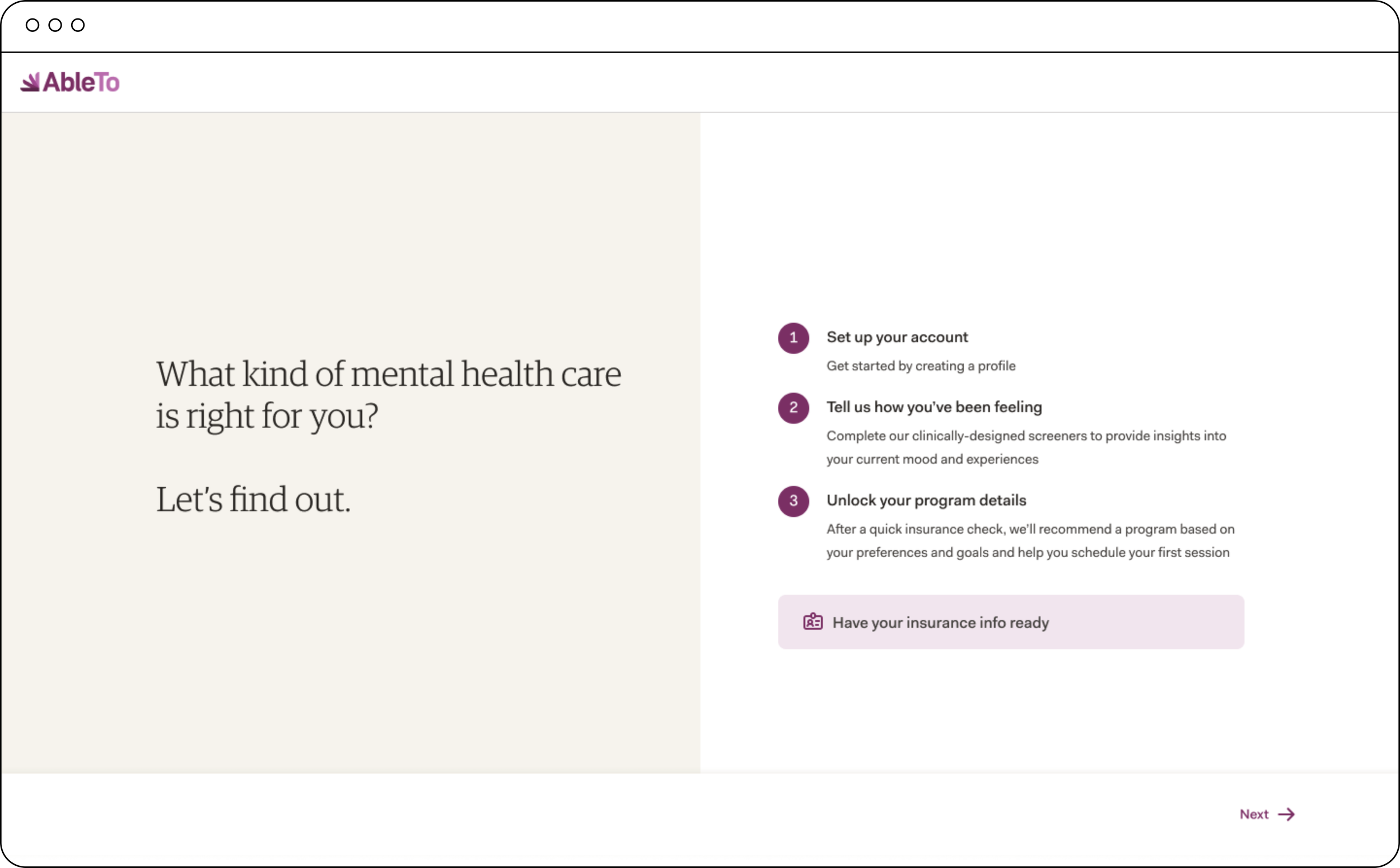
The self-sign up pod at AbleTo approached me to help solve a user problem uncovered from onboarding data: nearly 20% of onboarders were dropping off very early on in our onboarding experience, after the “warm up” screen.
The team hypothesized that the warm up screen may not be setting the right tone for the experience or encouraging users to continue with sign up. By revisiting that screen’s headline, we may be able to better set expectations for what’s to come and motivate users to continue with onboarding.
Goals
Ground users in our onboarding experience and set expectations for what’s to come
Promote the value of completing onboarding and signing up for mental healthcare
Build credibility with our users so they trust the information we’re providing
My Process
Step 1
Draft positioning options
Step 2
Manage stakeholder feedback
Step 3
User testing
Step 4
Synthesize & finalize
Step 1
Draft positioning options
Position 1:
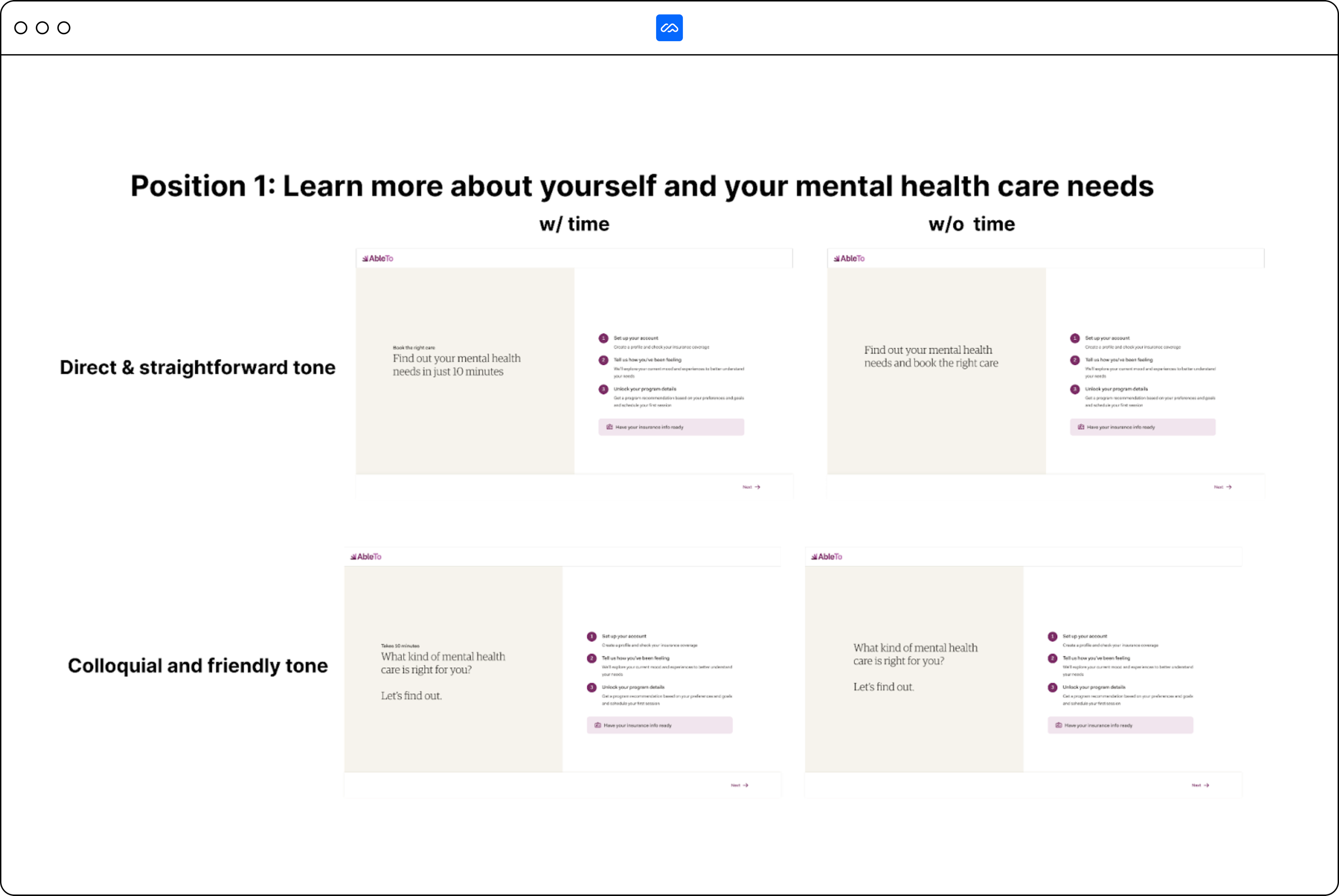
Learn more about yourself and your mental health care needs.
Supporting research
Our own past research suggests that some folks may not be convinced that they need mental health care due to stigma or their own perceived symptom severity.
Further research implies that our brains assign more dopamine to the learning of information we didn't previously know.
Because our onboarding experience includes standardized clinical assessments to measure symptoms of anxiety and depression, we felt that highlighting the output of those assessments could help educate users on their own mental health needs and motivate them to continue with onboarding.
Supporting user quotes
“I never thought I’d need some sort of behavioral or mental healthcare. Always thought I had a good mental grasp.”
Adam, 31
“I had been carrying it for so long that I didn't recognize it. Even when the [therapist said], ‘you have severe depression,’ I heard it, but I didn't [really] hear it. Because I'm the one everyone comes to in my family. I'm the one everyone asks for things. I didn't know it was [too] much. [...] I didn't realize I was spiraling.”
Tanya, 39
Headline options
Unlock a new level of self-knowledge in just a few minutes
Measure your mental health to uncover the right level of care
Ready to learn about your unique mental health needs?
Position 2:
We’ll help you find the care you deserve.
Supporting research
From our team’s past onboarding experience research, we learned that some people may not feel like their problems are worthy of care.
Because our onboarding experience offers care options for different levels of need, we felt it supported the idea that everyone deserves care, no matter what their needs may be.
Supporting user quotes
“[There’s a] vilification of mental health — that you only need to go into counseling if you are incredibly broken; [if you] have schizophrenia or some crazy extreme circumstances."
Bryan, 29
“I thought I needed to have a specific mental health crisis in order to deserve therapy. Once I started therapy, I realized that a crisis is an escalation of ongoing patterns that you're dealing with, and everyone could pretty much benefit from therapy.”
Cody, 29
Headline options
Let’s connect you to the care you deserve
You deserve to feel your best. Ready to take the first step?
Position 3:
Connect to care from the privacy of your home.
Supporting research
The same past research also taught us that many people want to keep their mental health concerns private
Since our onboarding experience is entirely digital, it upholds a high level of privacy for those who don’t feel comfortable sharing with another person.
Supporting user quotes
“I’ve been in America for a long time but maybe I’m still not 100% American. I know a lot of Americans go to therapy but my Eastern European mentality...you don’t talk about your issues with others. It’s how you’re raised.”
Sara, 51
“I think I've struggled somewhat with mental health pretty much most of my life. But unfortunately, in the Black community it's not something you talk about, it's not something you go and seek help for. It's more of a thing where you're just told, ‘oh get over it, pray about it’ and that's the kind of thought process I had growing up.”
Julia, 51
Headline options
Find trusted care that’s private and secure
Connect to care inside your comfort zone
Connect to care from the privacy of home
Position 4:
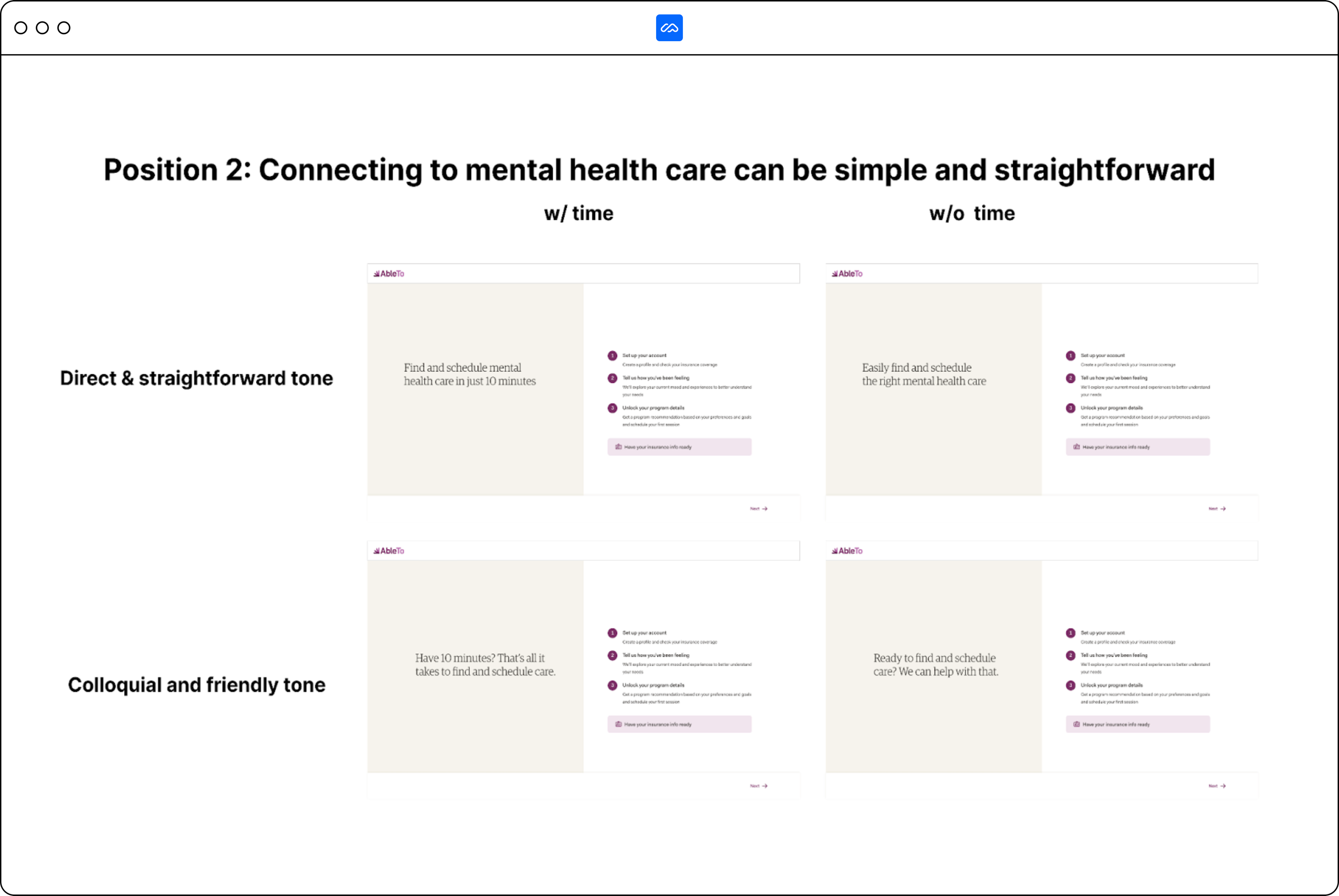
Connecting to mental health care can be simple and straightforward.
Supporting research
Our past research taught us that those seeking care often have questions about what may be right for them. They’re unsure of exactly what kind of care they’re looking for or where to start, and that can feel overwhelming.
Many also have specific provider preferences and want to find someone that meets their criteria, which can complicate their search.
Many face administrative hurdles when seeking care, which can further complicate and draw out the process.
Our onboarding experience combats this by offering provider selection and appointment scheduling in about 10 minutes.
Supporting user quotes
“I know that a lot of friends have wanted to find a non-binary or trans therapist and have not been able to find that, so I really lucked out there. Because it does make a huge difference; it was really validating.”
Cody, 29
“My big point of ignorance are the different types of counseling or therapy out there. I personally don't know what's the best fit for me. [My previous therapist] was a…[pause] I can't remember the full [name], I think it was a ‘problem-based something.’ Again, all the different theories and schools of it all, I don't really know which one is best. I'm just kind of throwing a dart. I'm more concerned with the person himself and trusting that he knows the best way to navigate whatever issues I'm coming to him with."
Bryan, 29
Headline options
Find the right care for you in just a few simple steps
We take the confusion out of connecting to care
Mental health is journey. Finding care doesn’t have to be.
Step 2
Managing stakeholder feedback
First, I brought these positioning options and headline drafts to design critique where we narrowed down to options one and four as our strongest contenders.
Then, I brought these options to the self sign-up pod. We found ourselves at a stalemate between the two positioning options. Our discussion unearthed critical questions about how to present and support these messages:
First, is it important to include an estimate for how long the onboarding experience will take, or might that deter users from continuing?
And, will our audience respond better to a more straightforward tone, or a friendlier tone?
Step 3
User testing
I partnered with our UX Researcher and pod Product Designer to design and launch our test, with feedback and support from our clinical, product, and design teams.
Our toolkit:
Figma
Maze
Miro
Google sheets
Maze user test

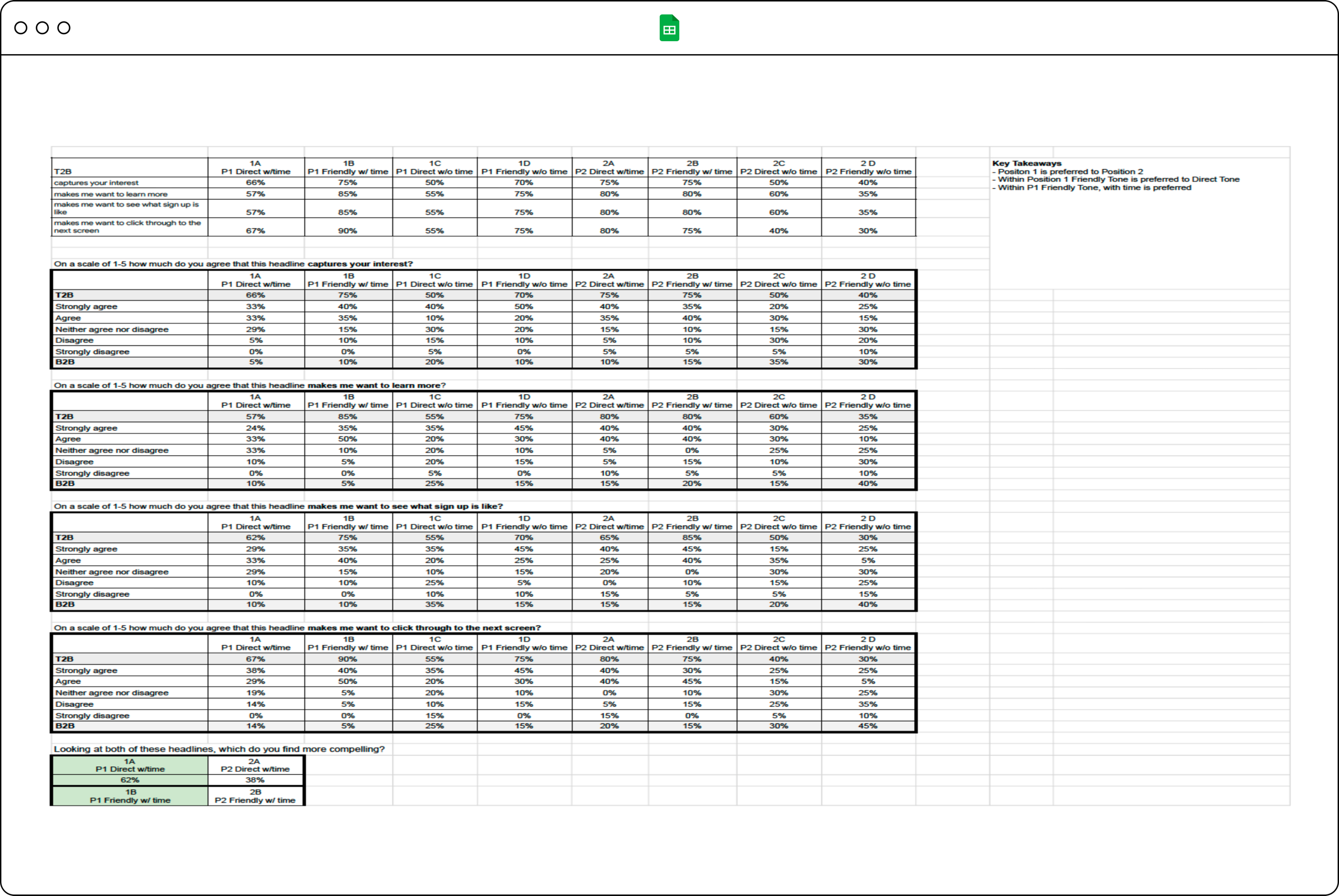
We launched 8 Maze tests in total. Each set of research participants saw one positioning option, with or without a time estimate, written in a friendly or straightforward tone.
Test summary:
10-second test
Set of Likert scale questions
Headline likes and dislikes
Preference between 2 options
Step 4
Synthesizing & finalizing
Qualitative feedback
Positioning
Most research participants preferred position one, because:
They felt that finding out their needs was most important
It insinuated personalization
It felt more inviting and genuine
Tone
A friendly tone felt more engaging, inviting, genuine, and natural.
Time
Some participants did not like seeing a time estimate on the warm up screen, while others appreciated it
No one mentioned time or had questions about time on headlines that did not include it
Quantitative feedback
Our UX Researcher took the lead on synthesizing quantitative data using Google sheets. Her synthesis supported what we saw from qualitative feedback, but showed a slight preference for position option one’s headline version with the time estimate.
Recommendation
Position 1, friendly tone, without a time estimate